The Cost Of Sports Capital
Why the cost of capital in sports depends on risk, not cash. And how colleges and federations should price and place it.
“It’s one banana, Michael. What could it cost? Ten dollars?”
— Lucille Bluth, Arrested Development
Warren Buffett famously said the "[c]ost of capital is . . . what could be produced by our second best idea. And then our best idea has to exceed that." Corporate finance textbooks teach that a firm’s cost of capital is the minimum value a venture must create to be worth doing. It primarily assesses the risk and reward of how funds are used, less so where the money comes from. The academic underpinnings of this thinking are almost 70 years old.
Engulfed by commercial pressures, amateur sports leaders are now invoking the term, too. But when they say it, the cost of capital is all about where money comes from, never about how it is used.
Two years ago, Sportico's Eben Novy-Williams observed “a number of athletics directors who have touted their ability to borrow money” inexpensively. Then-University of North Carolina athletics director Bubba Cunningham told him, “the cost of capital is fairly low for us.” Last year, American Conference Commissioner Tim Pernetti cast doubt on private equity involvement in college sports because “universities with significant endowments can borrow the money against their endowments at a far lesser cost of capital.”
There is more than a semantic difference between these two senses of the same term – cost of capital as opportunity cost for professionals, cash cost for institutions. The latter has led colleges and federations to covet low-cost financing above all else. Announcing Ross Stevens's donation last year to endow $100 million of payments to American Olympians, US Olympic & Paralympic Committee CEO Sarah Hirshland called it "the most meaningful thing we've done, . . . the most incredible thing we've accomplished." College leaders have courted federal restrictions on NIL payments that are outstripping their fundraising. One conference commissioner admitted, “I don’t think we have a Plan B.” So much for having a second best idea.
The cash they have relied on is only cheap at first glance. Athletics capital really costs a multiple of its booked expense. Institutions have paid the difference in their most important currency: control. Regaining it will require adopting Buffett's definition in two steps – pricing every risk, and placing it with whoever bears it most cheaply. For each institution’s athletes, donors, and community, that venture is worth doing.
Institutional athletics has always operated on what one might call cheap money. It comes in myriad forms – donor gifts; university, state, and affiliated support; tax-exempt bonds that leverage university credit; distributions and grants from governing bodies; and guarantees from commercial agents and licensees. But they share a common core: their cash cost is fixed over long periods of time, and priced well below the implied risk.
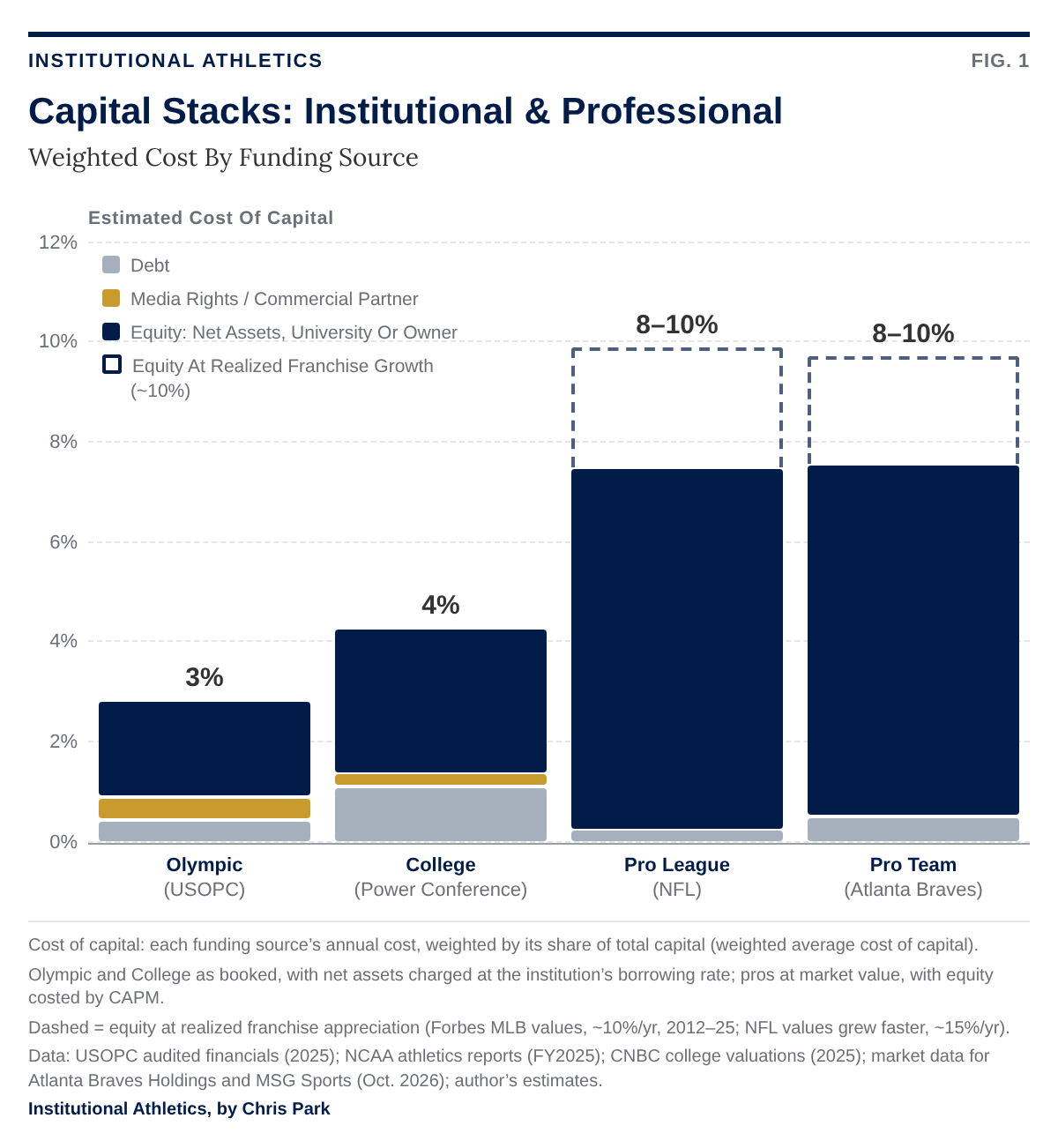
As a result, college and Olympic sports rely on funding that formally costs no more than 3-4% annually. Universities routinely refer to these levels as their system-wide cost of capital (equated to their cost of debt). In the background, leading American professional sports leagues operate at twice the funding expense.
In practice, institutional athletics funding is more expensive than the rate that institutions book. There are two types of additional cost:
- Implicit subsidies. Internal university loans tend to charge athletics less than the money costs campus. When refinanced, the terms are long-dated and favor athletics. Few Power Conference athletics programs cover their debt service with the margin that an arm's-length lender would require. To get cash guarantees from their arm's-length commercial sports partners – sponsorship sales reps, licensing agents, and the like – institutions usually give up significant, long-dated revenue shares and operating controls.
- Unpriced operating risk. Large donors often (rightly) expect non-cash returns, which may compete with other institutional initiatives. And college football and basketball are closely tied (both as talent feeders and business competitors) to the NFL and NBA, wherein teams and companies trade for a substantial risk premium. Exactly how big a premium is something of a moving target. On one hand, pro franchises are managed by more aggressive, transactional operators and investors. On the other hand, nonprofit college and Olympic sports teams work under fragmented, less coherent governance.
Accounting for these implicit costs more or less doubles the total sticker price of institutional athletics:
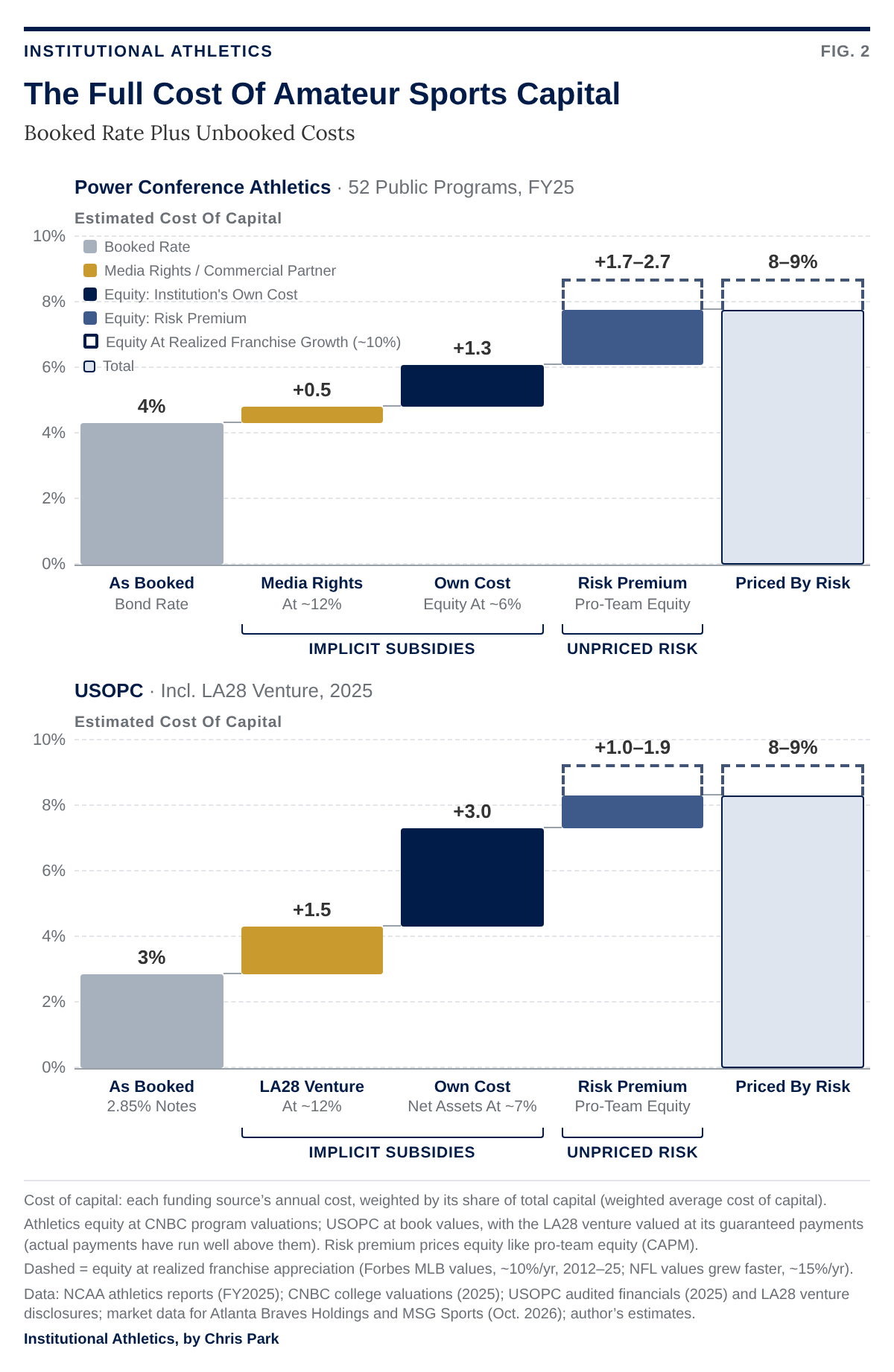
For every marginal dollar that institutions book in sports, they use another dollar or so that is unbooked. The 3-4% funding that sustains a powerhouse American college or national Olympic team costs closer to 6-7% after implicit subsidies, and rises to at least 8-9% after accounting for other corresponding risks. Just among public Power Conference programs as of last year, atop the roughly $840 million in reported annual institutional support and student fees, these implicit layers contributed more than $1 billion in cost.
That practice has its merits. It prioritizes philanthropy. It leverages the power of institutional parents, both university systems and international federations. And it slow-plays engagement with corporate influences. In times of stable spending and placid politics, these merits speak for themselves. Amateur sports would not be the worldwide phenomenon it is today without the luxury of growing up in a protective cocoon of higher education and international diplomacy since the 1800s.
But those times are over. Global inflation persists. Major ratings agencies issued negative 2026 outlooks for higher education, with S&P singling out the strain on academic budgets arising from House settlement revenue sharing payments. And the wealthiest private universities are beginning to manage large endowment tax rate hikes implemented in the One Big Beautiful Bill Act.
To maintain the patina of 3-4% operating capital, colleges and federations have traded long-term value to media companies and marketing agencies in exchange for discounted cash guarantees. Philanthropy has covered any residual shortfalls. Whether this swap is worthwhile depends on the price. Bringing the real price to the surface, and matching capital to its corresponding risk, is both an urgent need and enormous opportunity for leading institutions.
One way to understand the ongoing bickering over amateur athlete compensation is as a variant of Maslow's Hammer. If the only tool you have is subsidized financing, it is tempting to treat every cost as an identical risk. Consider International Olympic Committee President Kirsty Coventry’s explanation last May for why Olympians shouldn't be paid to compete:
Well, they get beautiful venues. They get beautiful villages. They get a beautiful experience. And all of that comes from the money we raise.
Conflating the costs of talent, stadiums, housing, and hospitality does not make them go away. To the contrary, it leads institutions to eventually pay what the market demands (directly and indirectly) but lose control of the underlying bargain in the process.
A prime example is sales and marketing. Institutions have historically relinquished control of their revenue operations to marketing agencies in exchange for long-term, stable guarantees. Recently, colleges have even coaxed their partner agencies to reclassify school revenue as NIL payments for their players.
A minimum guarantee is effectively a loan, repaid through shared revenue and priced to what it costs the payor (in this case an agency) to underwrite it. The small cadre of agencies that has rolled up hundreds of school and federation relationships pays for their clients' guarantees with money sourced from private equity and leveraged lending – ironically, a class of funding that institutions would reject directly. So-called MMR (multimedia rights) guarantees can cost schools double-digit annual returns once they flow through the agencies' capital providers.
It does not have to be this way. But achieving a different, better future means controlling the real cost of capital in two steps: price every risk, and place it with whoever bears it most cheaply.
- Pricing the risk: Measure the cost of all capital, not just what is booked.
A common stalemate on Power Conference campuses is as follows. The athletics department can source high-single-digit capital from outside the system. The CFO wants neither to authorize that external funding nor cover escalating losses from internal sources. More revenue would help but takes time (more on that later). The two sides are cordially frozen with indecision. CFOs cannot authorize what athletics directors cannot price.
Price, of course, needs a currency of value. In a for-profit firm, the currency is mainly financial return. A nonprofit organization's currency should be impact on its mission. But athletics institutions too frequently invoke their mission as a reason not to measure impact at all. Recall recent declarations from a University of Michigan regent that they are "stewards of something bigger than a balance sheet," and from the Association of Summer Olympic International Federations that "one cannot and should not put a price on an Olympic gold medal."
Such sweeping pronouncements are not wrong. But they neglect the practical guidance that executive leaders need. Specifically, what success distinguishes high-performing athletics institutions from low-performing ones?
The answer depends on the ambition an institution selects – that is, what mission it defines. In Spending In Place, I described how the diverse weight classes of schools emerging in post-NIL college sports are spending more money to little competitive effect. Blue bloods that set talent prices can operate at break-even; laggards need subsidies but can size them to what their teams competitively achieve. Olympic federations vary not just competitively, but also by how they allocate resources between elite competition and sub-elite participation, and how they administer crucial regulatory functions like SafeSport. Each commitment needs to be defined specifically and priced separately.
Absent a fully integrated and specified mission, institutions struggle to consistently price risk within athletics as opposed to outside it. Consider the University of Iowa. In 2019, Iowa auctioned a 50-year concession to run its utility system for $1.165 billion, modeling the proceeds to earn 5% annually. Two years later, Iowa lent its athletics department $50 million – and last year fixed the interest at 2.5% and doubled the term to 30 years. None of this is untoward. It merely reflects the ambiguity of mission common at the most competitive levels of amateur sports.
Whatever the selected mission, the same financing rule can apply: fund operating losses with fixed-term money at an institution's true internal cost. Practically, that means charging athletics closer to the 6-7% it costs than the 3-4% institutions book today. This discipline is an achievable standard now that the most bewildering years of NIL are done. Universities that ran significant, surprising deficits in the early part of this decade, including Arizona, have settled into steadier patterns since. When internal funds are accurately priced, CFOs and operating executives can negotiate the rest together – streamlining operations, further refining their shared mission, or both.
- Placing the risk: Assign it to the party that can bear it most cheaply.
Once they price all of their operating risks, institutions can thoughtfully place each one with whichever party can bear it most cheaply.
Sometimes, that party will be the institution itself. Consider sales and marketing again. Describing the rationale for outsourcing back in 2005, then-Host Communications executive Steve Angelucci said, “It gives you guaranteed revenue regardless of the coach’s or team’s performance.” Revenue is now a key input to performance. Institutions are beginning to realize that revenue is a risk to be directly managed, forming new business entities and hiring new business staff. But their adaptation remains largely cosmetic. The United Sports Collective, a joint sales venture of national governing bodies, immediately hired a marketing agent upon launch. And most new internal college business entities are still nonprofit arms reliant on incumbent agencies.
These long-lasting commitments tend to unfold like one-way options for agency partners. Many Learfield schools whose guarantees were reduced during COVID nevertheless maintained the relationship. Last month, the University of Georgia extended with Learfield for fifteen more years – eight years longer than the Southeastern Conference's current partnership with ESPN. To its credit, the USOPC is preparing to create its own commercial arm, US Olympic and Paralympic Ventures. But it remains to be seen how effective that contemplated entity can be while LA28 controls U.S. Olympic and Paralympic Properties, the joint venture formed in 2018 that manages Team USA's rights, through the 2028 Games. All of this is a far cry from pro sports, where service rollups are incubated by the most entrepreneurial teams themselves.
At other times, the party best positioned to bear the institution's risk will be its partners. Take public-private partnerships (P3s). A growing number of universities is collaborating with sports hospitality and finance firms to develop entertainment districts around their stadiums. The University of Tennessee's venture, 865 Neyland, is patterned after similar pro team projects; its partners, in fact, hail from the pros. But unlike pro deal structures, 865 Neyland appears to stick UT with the project's $83 million garage construction even if the $288 million district doesn't get built – the type of downside a developer would absorb in a comparable pro team deal.
Tennessee's rebuttal to recent scrutiny is that the project, as athletics director Danny White put it, “is being built, and funded, by private developers.” Major universities know that the linchpin of P3 best practices, as World Bank guidelines explain, is less who strokes the check than who bears the risk. Another UT, Texas at Austin, placed more substantial risk than Tennessee onto Oak View Group in their joint venture developing the Moody Center. That venue has since become one of the highest-grossing arenas of its size.
Still other times, the best risk bearer will be institutions – but in groups of peers. A critical feature of American pro sports risk management is league-wide credit facilities. These contingent pools of capital – over $20 billion combined in the NFL, the NBA, and MLB – arm teams with highly rated, bankruptcy-remote credit favorably priced against their national revenue. No such vehicle serves the college and Olympic sectors, whose members have chronically balked at perpetual partnerships and shared financing rules.
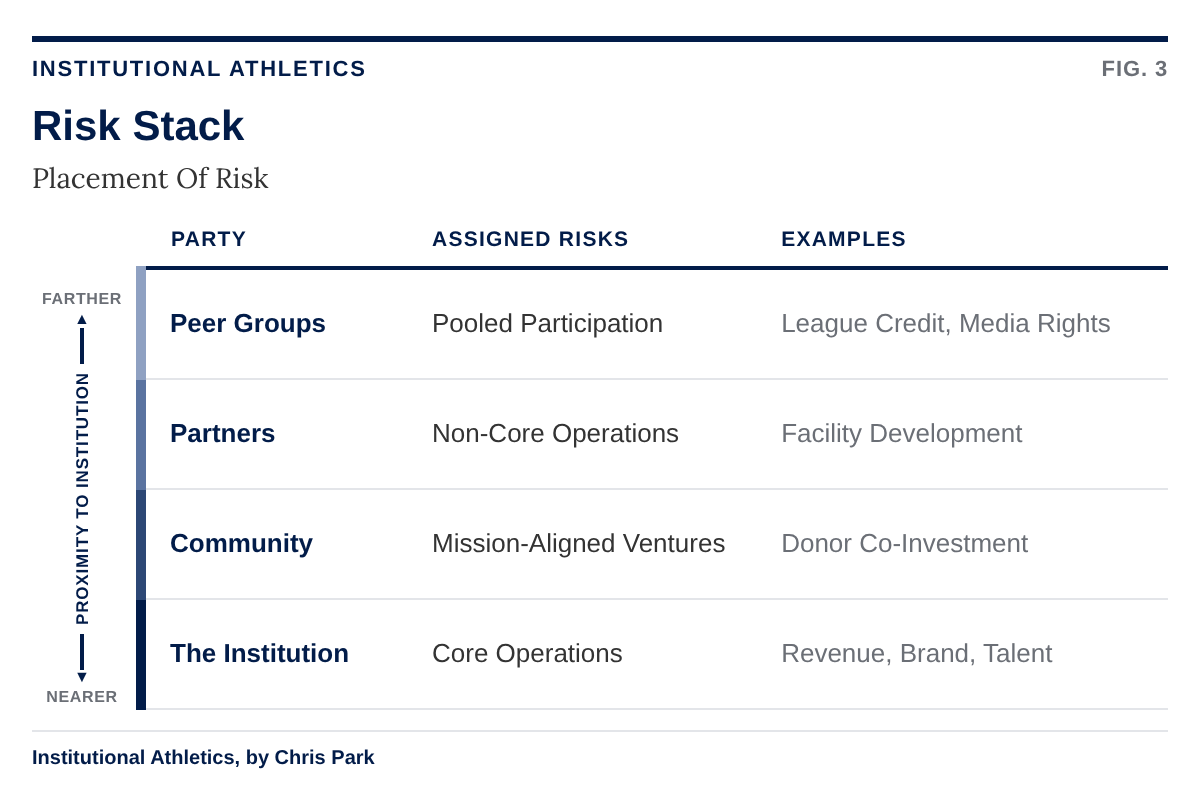
Finally, the best bearer of risk can be an institution's own community – as long as the community is duly compensated. The practice of neglecting to price risk has overcompensated some amateur sports partners and undercompensated others. Agencies and similar operating intermediaries have received too much for providing commoditized services. Donors and taxpayers have received too little for backstopping institutional missions. The donor fatigue widely reported in college sports is with having to support uninspiring ends. Few donors are tired of giving in general.
Once the relevant risks are properly priced, donors and other “insider” community members ought to be – if they so choose – the investment capital of first resort, not just the philanthropic subsidy of last. Model structures abound outside athletics, from donor-backed funds in medical research to mission-based institutional funds like MIT's The Engine. They don't yet enable sports community members to compensably share the risk that today is funneled through more transactional, less forgiving partners. This is an opportunity for colleges and federations to innovate – and a timely one, as donor-advised fund assets skyrocket.
The task for institutions is to facilitate mission investing that best fits their athletics commitment. For leading institutions, this means energizing the most affluent donors within parameters that still include the broader base of supporters and keep governance norms in place. One half of the task is to accurately price the ventures that need investing. The other half is to create returns that serve the unique interests of community members. These include integrations with estate planning and other charitable tax efficiencies – terms that disinterested funds don't really care about.
University of North Carolina System President Peter Hans recently opined that "the college athletics model has never been more broken. And yet, it has never been more popular." The optimism and pessimism of institutional athletics both stem from the outside world's intensifying interest. If you think that interest will abate any time soon, consider the following paean to institutions:
In a world of abundant intelligence, certain scarce human experiences may matter more. In a world of fragmented distribution, trusted institutions may matter more. In a world where content and software become easier to create, assets rooted in identity, culture, community, history, and physical experience may become more valuable.
That may sound like the script of a university or federation trustee. But it's an excerpt from Joshua Kushner's first investor letter for Thrive Capital, which is part of a consortium buying the Los Angeles Lakers and was the anticipated lead investor in FIFA's aborted sale of World Cup equity.
Amid ongoing disruption, institutions can reinforce control of the sports teams they built over calmer decades. That control used to depend on pricing and conserving cash. It now depends on pricing and placing risk. It’s an achievable ambition, but it will not happen by accident. As Warren Buffett also famously said, "Risk comes from not knowing what you're doing."